Damn Good Content To Grow Your Business In The Digital World
Insights, Ideas and Innovations from the brains of the Saucal NERDS.
SAU/CAL Interviewed by Clutch for Expertise in WooCommerce
07 Mar
2018-03-07T19:54:06-04:00
Our team is still proud of our recent recognition as a top e-commerce developers in Canada by Clutch. As a result of this achievement, they reached out to interview us on our expertise in the field. I was thrilled to talk to them about the strengths of WooCommerce and provide my insights.
Clutch is a B2B ratings and reviews platform designed for agencies and buyers in the IT sector. Beyond company profiles and client reviews, they also produce research on website builders such as e-commerce platforms. There are many things to take into account when creating an e-commerce store before deciding what platform to use. As I said:
“E-commerce comes down to the basic requirements—whether someone is selling physical or digital products, figuring out shipping, payment and tax options and so on. It requires a bit of planning upfront, but, as with anything, we need to dream big and start small. It’s a different story for bigger companies, but those may be the ones who need to take the biggest leap of all—adapting to the paradigm of online selling, versus retail locations.”
With all this in mind, clients typically come to us to start a store from scratch, build out new features and extensions or upgrade the platform. While there are many great options out there, we are believers of open-source technologies and work exclusively with WooCommerce.
“WooCommerce is open source, which makes it highly customizable and flexible. Compared to software like Magento, it’s also quite lean, without a lot of technical debt…It’s still a young platform—having been released in 2011—but it’s already a massive part of the e-commerce market. More than 30% of all e-commerce sites are using WooCommerce.”
However, as with any development and design project, there are always areas to be cautious. I highlight this by sharing:
“WooCommerce provides a lot of power, but it can be daunting for non-technical people. Since there are so many extensions available for it, installing a badly written one can easily take an entire store down. People without a lot of good technical talent, or ones who don’t want to invest too many resources in the technical side, should use something like Shopify. For truly basic stores, Squarespace can be an option. These eliminate technical hurdles and keep things simple.”
Thank you to Clutch for thinking of SAU/CAL and including us in your research. We were happy to share our knowledge with you. Check out the full interview for more great information!
SAU/CAL is made up of dedicated, tech-savvy individuals who produce high quality e-commerce solutions. We make sure that the stores we develop help a company thrive in the increasingly digital universe. This is why we are excited to announce that our hard work has paid off and we are now recognized as one of the top e-commerce developers in Canada by Clutch.
Clutch is a B2B ratings and reviews platform that connects businesses with the best-fit agencies, software, or consultants they need to tackle business challenges together.
The new report they released looks at the top developers in both the UK and Canada. To determine the leaders, Clutch evaluated the companies based on a unique methodology that took into account each company’s verified client reviews, services offered, work quality, and market presence.
We are proud of our seven reviews and overall 5 star rating from our clients. Check out some of the awesome comments they shared on our profile:
“They don’t just deliver on what they say they will deliver on, they make recommendations that are even better. They take your feedback, adapt and deliver on that as well.”
“The most impressive thing was how the nimble the team was and how fast they were able to deliver on such an excellent product.”
“The quality of work for the value is amazing, because you get high quality work for a very reasonable price. They’re very fair in the way they charge.”
“The most impressive thing was their friendliness. They were great at communicating and being quick, but they were very friendly, easy to get along with, and very humble…I appreciated how candid and honest they were. They were completely transparent.”
Our team is thrilled to be one of the top three e-commerce developers in Canada and would like to thank Clutch for including us in their research. We look forward to maintaining our rank and beginning new e-commerce projects soon.
Formally starting today, we’d like to introduce our newest partner, ShipStation.
Shipstation is awesome, they:
are the most powerful shipping management tool in the industry
provide the lowest rates for shipping
allow you to easily print your own shipping labels
have GREAT metrics that help you constantly perfect your shipping rules and prices
You know us. We’re Saucal. We’re pretty awesome too. We:
always give you that crucial extra technical help whenever you need it so you can keep being awesome.
share your values. We’re:
reliable
constantly improving ourselves to better meet our clients’ needs
strive to make your life easier
all about making your customer experience the best it can be
ShipStation and Saucal Together?
We can take over the world. Or at least the part of it that has to do with shipping. With ShipStation’s leading shipping and fulfillment software and our eCommerce expertise, there is no limit to how you can grow your business.
Configuring the Canada Post Custom Declarations Form via the API
11 Apr
2017-04-11T10:51:18-04:00
I had a question roll through on the WooCommerce Slack, which I think could be of assistance to our readers –
When shipping using Canada Post, the majority of orders go from CA to USA. So there needs to be a “customs declaration” form for each order. Apparently this “customs declaration” form is somewhere readily available in the Canada Post account. How do I know?
Well, the client is sick and tired of having to bounce back and forth for every order and jumping back into the Canada Post dashboard just to retrieve the “customs declaration” form. Is there a way to ‘pull’ this info from the Canada Post API?
Lol, somewhat dramatic – anyhow, it’s completely possible. Thanks to the helpful folks at Canada Post, here is a guide on how to get it done.
—
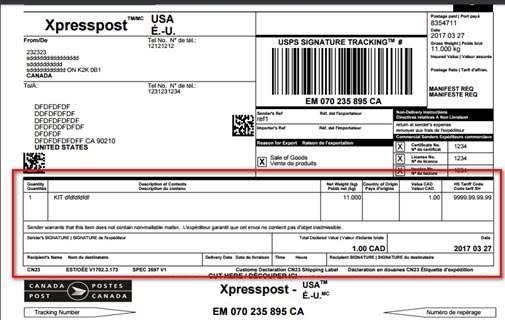
Via the API, Canada Post always return the custom forms for USA/Intl destination. It can be combined with the shipping labels, or in some instances it comes separately. This is where it becomes important to make available all copies when you get an answer back from Createshipments. It would require also that on the front end, you offer the capability for the end user to fill in the customs information.
Below are 2 examples where you see the customs info combined with the shipping labels. The 2nd example shows where it is a separate copy. It all depends on the shipping service and paper format opted for.
#1 Xpresspost USA (Canada Post combines the custom info on the shipping label)
Notice the answer, we only one instance of the endpoint name : LABEL
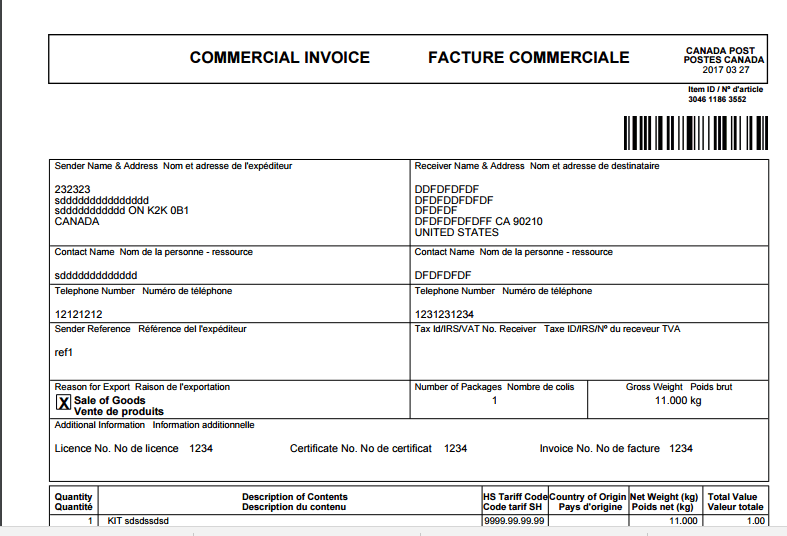
#2 Here is an example where Canada Post returns 2 labels, one outgoing and the second is a commercial invoice needed with the shipments for customs purposes.
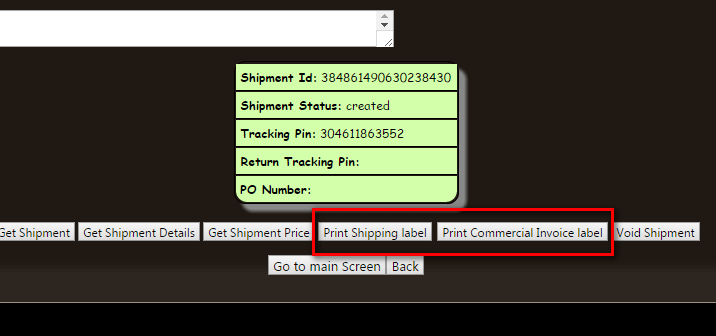
When receiving the answer back from Canada Post, I always read the entire answer back using for each, so I can capture everything back from Canada Post and translate in a button:
Here is the printout of the second test showing 2 different copies for this shipment:
—
There you have it folks. Thanks again to the team at Canada Post for helping to put this together.
So, as per usual, I was chatting with someone about the inner workings of WooCommerce. In this case, it was Patrick Garman. Reason being, I get a lot of questions of whether or not a business should use Shopify, or WooCommerce. For me, the answer is simple: with WooCommerce, you own your shit. That alone is enough reason to end the conversation. However, let’s take it a bit deeper. More often than not, this boils down to technical expertise vs. convenience.
Please note that some text has been redacted and replaced with equivalent statements, omitting references to individuals or projects.
cally
Hey Patrick amigo, quick q for you..
I’m working on getting a pretty good sized retailer onto WooCommerce. They’re very much a recognized brand. However, for bandwidth/usage it’s not too intense ((I have a breakdown of this, but I cannot share it all. However, per day, it’s estimated to be 600-800 page views and 30-40 orders.)).
cally
They asked about “clunkiness” in WooCommerce, and I was wondering if you had a chart, or threshold where you start to see this?
pmgarman
Really depends on the site and how it’s built, to be honest REDACTED [we’ve built and run WooCommerce sites with databases over 100GB in size, which ran better than some sites that have databases less than 1GB].
Do you have new relic or anything running?
cally
It’ll be built from scratch and put on an entry level dedicated box at WP Engine, so we could run New Relic.
At this time they’re contemplating platforms, and it’s between Woo and Shopify.
They’re familiar with REDACTED. 😉
pmgarman
Well if you need to bring in some expertise,
I’m not longer at REDACTED 😉 REDACTED is my sole focus.
cally
I saw.
I creep you once and a while, y’know? 😉
pmgarman
Ha keeping tabs on me
cally
Lol
Mostly wanna know what you have your hands in!
pmgarman
We’re working with REDACTED on their managed platform and part of that is *the* feature plugin for custom order tables
cally
Deep down tho, you still hardcore Woo? Or, if a large brand lands on your doorstep, would you ever recommend Shopify? What would that tipping point be?
pmgarman
Just to start 😀
cally
I’m like 100% against Shopify, lol. But I haven’t put it all into words yet.
pmgarman
I work heavily on both now, depends on their level of customization and how much they want to “manage” it
cally
*the* feature plugin for custom order tables
You’ve always got your hands in something good!
pmgarman
It’s good for someone who has a simple site and doesn’t want to deal with the headache of WP/WC
cally
depends on their level of customization
How far can you customize Shopify? For example, could you easily add subscriptions, or multi-language as an add-on? I’ve never built on it.
pmgarman
multi language basically means you run multiple stores, thats essentially your only real option
customizations, you can customize the html essentially. and then whatever you can do via the API.
with enterprise “plus” plans, you can do a bit more. but thats minimum $2k/mo. and that is now going to go up a lot from my understanding
unless you are paying $2k/mo, your checkout URL is my.shopify.com or something
cally
Yea they’re definitely considering Plus, and it’s funny you mention price, because that is definitely an uncertainty I wondered about.
pmgarman
plus: it can handle a significant number of orders/min. REDACTED
con: all customizations are significantly more involved
cally
To me it sounds like the advantage of Shopify is:
– Allows for a lot of orders.
– No worries for maintenance
Is that about it?
pmgarman
apps have long term costs you can’t ever get away from. customizations of your own if it touches the API means you need to host and run your own custom application
yeah thats the main points
a lot as in, it handles the biggest flash seller in the world
cally
lolol
Good to know.
pmgarman REDACTED
cally
So a very extreme edge case.
What about the payment gateway, too? I think they penalize you for not using their’s, correct?
pmgarman
they don’t “penalize” you, but, you don’t get the benefits their white label stripe offers.
stripe won’t even talk to you if you are using shopify, you *must* use their shopify payments
cally
I heard they add a % point for using a 3rd party.
pmgarman
which you don’t get your own stripe
yeah you have transaction fees unless you use theirs. but i’m not sure if plus changes that
cally
So the benefits really aren’t that much.
IMO
Then concerns if the company goes bankrupt, restricts features, etc. It’s a lot to pay for some convenience.
About Woo scalability, progress is being made then, as you’re working on it now?
pmgarman
the benefits to the lay person is “you dont have to manage your site, they do it for you” where WP/WC you *really* have to manage it. you need someone monitoring it if you are doing any sort of volume or want to run it right, you need to deal with updates/etc
cally
Okay, so assuming they have a Saucal or Patrick Garman, they’re covered. Plus, all the benefits of full flexibility and ownership.
Patrick GarmanREDACTED
pmgarman
yeah basically
tl;dr – if you are paying more than $2k/mo to run your site (hosting and maintenance), then it’s worth considering, if you have a simple site that doesn’t require much customization.
without plus you can’t even use the discounts api
so you can’t create coupons unless you do it by hand
$2k/mo to have the power to import coupons
at the end of the day i’ve worked on the largest WC site ever, and now the two largest Shopify stores ever. I’ve broken things on both, Shopify has banned my API keys because i was stressing things.
cally
Lol, you’re the man.
And that’s at current pricing. If pricing goes up at Shopify, things change.
What are the two sites on Shopify?
pmgarman
Which, it is going up
i don’t know if they have publicly said it or not. plus is now also a transaction or % based model
cally
You know by how much?
pmgarman
let me look it up, i can find out from some other people. REDACTED was grandfathered in
REDACTED was #2 at shopify, REDACTED was #1
cally
That would be great. And, is it okay if I share this information? Ofc, I want to ask you first.
Dude, how do you land these all star customers?
pmgarman REDACTED wasn’t a client, REDACTED was my full time job, REDACTED was under the umbrella of REDACTED and REDACTED was the second brand. REDACTED < i built that site
cally
I’m gonna wear a Patrick Garman t-shirt at WooConf ((I guess you’ll know how to find me!))
pmgarman
theres a lot of separation and similarities at the same time. but at the end of the day architecturally what my role became when on shopify was connecting things together and building internal tools and applications
ha you should. some mindsize jerseys, garman on the back
cally
hahahaha, i was thinking more like those rapper t’s.. your face on the front.
Maybe wearing a crown ?
my role became when on shopify was connecting things together and building internal tools and applications
And these were hosted off-site, therefore putting you back in the realm of maintenance, etc.
pmgarman
haha
yeah it was a custom application that i developed myself (built on laravel spark) from the “ground” up
thats how we did reporting, i exported all shopify data through the API, thats why ops hated me
would run 20 threads of API calls
cally
wow, so exporting the data pounded the API and they didn’t like it..
ha damn.
pmgarman
yep – which doesn’t support shopify, yet
bryce has promised me an API 🙂
cally
lol
So, there you have it. Whether you like it or not, you’re going to need some technical chops. Might as well suit up, or let us handle it. Trust me, it’s a lot better than censorship, or this.
WooCommerce Subscriptions and Payment Gateways, Who Manages What?
21 Feb
2017-02-21T15:41:26-04:00
We had a question come through, followed by a tweet. The tweet went on it’s own tangent talking about things not previously discussed, however it did raise a good question about payment gateways and WooCommerce Subscriptions.
Q:
I was always under the impression that in Subscriptions, it does not set up a recurring profile on the payment provider, rather Subscriptions sends single charges each month to the payment gateway ((By no means are we implying storing credit card data on the local server. This is a question of using a token and where and when charges are authorized from. This is explained in the answer.)). I know at least it’s that way in Stripe. But I had a guy come through, and said I was wrong for PayPal.
A:
You are right for almost all gateways. With PayPal Standard (and one or two other gateways, like WorldPay), the only option is to create a subscription at the payment provider. With all other gateways, including PayPal Reference Transactions (also built into Subscriptions, but requires special approval from PayPal’s end before it can be used) we just need a payment token, and can do everything else ourselves ((This is what I was referring to.)). Although that said, for PayPal Reference Transactions, the “token is actually a billing agreement, so the custom can still cancel/suspend that billing agreement at PayPal. AFAIK, there is no PayPal product which does not allow the customer to also manage the recurring payments. Something like PayPal Pro, which is just a credit card gateway, might do that though. But in those cases, you’d just want to use Stripe or something better anyway.
So there you have it. If you’re using PayPal Standard, or 1 or 2 other gateways, the subscription is managed on their platform. Otherwise, it’s managed within Subscriptions directly. And by “manage” I don’t mean it’s storing credit card data locally.
I hope that clears things up. Cheers to the team at Prospress for the answer. 😉